

Part 2 of a Series on How Refractive Index Shapes Optical System Design
From Refractive Index to Fiber Architecture
In Part 1 of this series, we introduced refractive index (RI) as a subtle but powerful material property – one that shapes how light bends, reflects, and propagates through optical systems. In this article we will look at high-power laser optical fibers, where refractive index directly determines how efficiently pump light is captured, how compact a system can be, and how much power the fiber can handle before losses, heat, or instability become limiting factors.
High-power laser optical fibers are the core enabling components in modern fiber laser systems, where light generated inside a glass fiber is amplified to hundreds of watts or even kilowatts of output power. These devices are widely used in industrial materials processing (cutting, welding, and engraving), defense and aerospace systems, scientific research, and emerging applications such as directed energy and advanced sensing.
This YouTube video by JPT provides a good basic overview of the construction and operation of fiber laser devices.
Compared to traditional solid-state lasers, fiber-based lasers offer high electrical efficiency, excellent beam quality, compact form factors, and robust thermal management – but achieving those advantages at high power places strict demands on fiber geometry and materials.
To understand why ultra-low-refractive-index materials like amorphous fluoropolymers (AFPs) are interesting in this context, it helps to first look at what materials and structures are commonly used in laser optical fibers today.
Typical High-Power Laser Fiber Construction
Most high-power fiber lasers rely on some form of double-clad fiber geometry. While implementations vary, the basic structure is consistent:
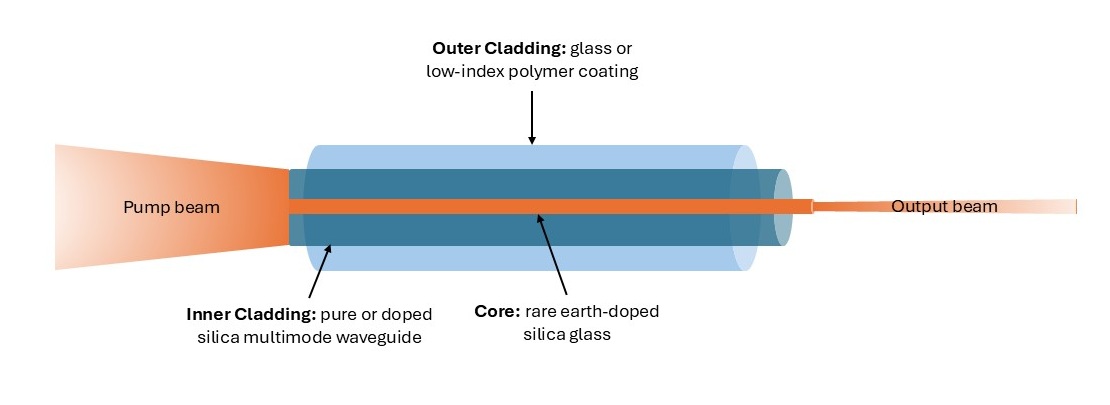
The core: where the laser light is generated
- Material: Rare-earth (e.g., ytterbium) and aluminum co-doped silica glass
- Function: Serves and the gain medium for the laser, and also as the core portion of the waveguide for laser output optical power, often in a single transverse mode
- Why silica: Exceptional optical damage resistance, tolerance for high temperatures, and decades of proven reliability
The refractive index of the core is typically around 1.45 at 1.06 µm, modified slightly by dopants. For high-power systems, silica as the core material remains unmatched.
The inner cladding: where the pump light lives
- Material: Pure silica or silica doped down with fluorine to reduce RI
- Function: Captures multimode pump light and guides it alongside the core, also serves as the cladding portion of the waveguide for laser output optical power
- Design trick: Non-circular geometries (D-shaped, octagonal, asymmetric) scramble pump rays to improve absorption
Silica also dominates as the preferred inner cladding material. In high-power lasers, the refractive index is only slightly lower than the core, typically ~1.44–1.45, in order to reduce the number of supported optical modes in the output laser waveguide while maintaining a relatively large core diameter.
The outer cladding: where refractive index matters most
The outer cladding layer defines the numerical aperture (NA) of the pump waveguide. This layer is where designers have the most freedom – and where refractive index becomes a genuine design lever. The common choices today:
Polymer outer claddings (most commercial systems)
- Fluorinated acrylates, silicones, or related polymers
- Refractive index typically ~1.37–1.40
- Easy to apply, flexible, inexpensive, compatible with draw-tower processes
These materials are “good enough” for many hundreds of watts, but they limit index contrast and pump NA.
Air-clad or micro-structured designs (high-end niche)
- Use air holes or gaps to achieve an effective RI near 1.00
- Enable extremely high NA and pump confinement
- Fragile, complex, expensive, and difficult to manufacture
These designs are used in research, defense, and specialty systems – but not mainstream production.
This leaves a gap between conventional polymers and air – solid materials with significantly lower refractive index than today’s polymers.
Where Amorphous Fluoropolymers Fit
Amorphous fluoropolymers could fill that gap.
With refractive indices typically in the 1.29–1.35 range, AFPs offer a level of index contrast that conventional polymer claddings cannot reach – while remaining solid, continuous, and chemically inert. From a fiber-laser perspective, this enables:
- Higher numerical aperture without resorting to air structures
- Improved pump light capture, especially in compact or tightly bent fibers
- Lower scattering, due to the amorphous (non-crystalline) structure
- Environmental resistance, protecting silica from moisture and chemicals
- Higher temperature stability than traditional polymeric coatings
Importantly, AFPs are not speculative materials. Decades of work in high-power optical coatings and integrated photonics have shown that they can tolerate intense photon flux while maintaining optical clarity.
| Fiber Layer | Common Materials | Typical RI | Why used? |
| Core | Rare-earth-doped silica | ~1.45 | Power handling; reliability |
| Inner cladding | Silica/F-doped silica | ~1.44 – 1.45 | Pump guidance; thermal stability |
| Outer cladding | Fluorinated acrylates; silicones | ~1.37 – 1.40 | Manufacturability, low cost |
| Air holes / gaps | ~1.00 | Maximum NA, niche systems | |
| Amorphous fluoropolymers | ~1.29 – 1.35 |
High Δn without air |
Table 1: Summary of high-power laser optical fiber materials in use today
Why AFPs Are Not Everywhere Already
If AFPs offer such compelling optical properties, why aren’t they widely used today? Because high-power fiber lasers are constrained by more than optics alone.
Key tradeoffs include:
- Thermal limits: AFPs soften or degrade at temperatures well below silica. In kilowatt-class systems, heat in the cladding can exceed what polymers comfortably tolerate.
- Photodegradation: Prolonged exposure to stray UV or short-wavelength light can create absorption centers.
- Cost: AFPs are significantly more expensive than commodity polymer coatings.
- Qualification inertia: Fiber-laser manufacturers are conservative by necessity; materials must survive years of validation.
As a result, AFPs are unlikely to replace conventional polymer claddings in mainstream industrial fiber lasers. Instead, AFPs become attractive when conventional materials hit a performance ceiling and system value justifies pushing beyond it – in other words, when performance outweighs the tradeoffs. Typical examples include:
- Specialty double-clad fibers requiring exceptionally high pump NA
- Large-mode-area fibers used in research, defense, or advanced manufacturing
- Compact or tightly coiled systems where pump confinement is otherwise lost
- Harsh environments involving chemicals, radiation, or moisture
- Low-volume, high-value systems where performance matters more than material cost
In these use cases, ultra-low refractive index shifts from theoretically interesting to a potential system-level advantage and the question becomes “Are AFPs the only solid material that enables this design?” instead of “Are AFPs the cheapest option?”
Up Next
In high-power fiber lasers, low refractive index improves how light is guided and confined inside the system. In other optical applications, low refractive index plays a different but equally important role – managing reflections at surfaces exposed to extreme optical intensity.
In Part 3, we’ll turn to antireflective coatings for high-power optics, where amorphous fluoropolymers have already demonstrated exceptional performance and where ultra-low refractive index directly translates into higher damage thresholds and cleaner optical interfaces.
Learn More
Interested in how amorphous fluoropolymers can advance your cutting-edge research or new product development? Our team at Chromis Technologies is here to help.
Contact us to learn more about our materials, capabilities, and how we can support your innovation initiatives.
References
Robert Chow, Maura K. Spragge, Gary E. Loomis, Ian M. Thomas, Frank Rainer, Richard L. Ward, Mark R. Kozlowski, “High-damage threshold antireflectors by physical-vapor-deposited amorphous fluoropolymer,” Proc. SPIE 2114, Laser-Induced Damage in Optical Materials: 1993, (28 July 1994); https://doi.org/10.1117/12.180886
Richardson, D.J.; Nilsson, J.; Clarkson, W.A. “High power fiber lasers: current status and future perspectives.” J. Opt. Soc. Am. B 27(11), B63–B92 (2010); https://doi.org/10.1364/JOSAB.27.000B63
Álvarez-Chávez, J.A.; Offerhaus, H.L.; Nilsson, J.; Turner, P.W.; Clarkson, W.A.; Richardson, D.J. “High-energy, high-power ytterbium-doped Q-switched fiber laser.” Optics Letters 25(1), 37–39 (2000); https://doi.org/10.1364/OL.25.000037
Laperle, P. et al. “Yb-doped LMA triple-clad fiber laser.” Proc. SPIE 6343 (2006); https://doi.org/10.1117/12.707712
Tankala, K.; Guertin, D.; et al. “Reliability of low-index polymer coated double-clad fibers used in fiber lasers and amplifiers.” Optical Engineering 50(11), 111607 (2011); https://doi.org/10.1117/1.3615653
Janani, R.; Majumder, D.; Scrimshire, A.; et al. “From acrylates to silicones: A review of common optical fibre coatings used for normal to harsh environments.” Progress in Organic Coatings 180 (2023) 107557; https://doi.org/10.1016/j.porgcoat.2023.107557
Chow, R.; Spragge, M.K.; Loomis, G.E.; Thomas, I.M.; Rainer, F. “High-damage threshold antireflectors by physical-vapor-deposited amorphous fluoropolymer.” Proc. SPIE 2114 (1994); https://doi.org/10.1117/12.180886
Chow, R.; Loomis, G.E.; Spragge, M.K.; Kozlowski, M.R. “Amorphous fluoropolymer: next-generation optical coating candidate.” Proc. SPIE 2253 (1994); https://doi.org/10.1117/12.192127
Leosson, K.; Agnarsson, B. “Integrated Biophotonics with CYTOP.” Micromachines 3(1), 114–125 (2012); https://doi.org//10.3390/mi3010114
Theodosiou, A.; Kalli, K. “Recent trends and advances of fibre Bragg grating sensors in CYTOP polymer optical fibres.” Optical Fiber Technology 54 (2020) 102079; https://doi.org/10.1016/j.yofte.2019.102079
Frequently Asked Questions (FAQs)
What is meant by “single transverse mode” in the context of how the optical fiber core guides the laser signal?
When an optical fiber operates in a single transverse mode, it means the laser light travels through the core in one clean, well-behaved pattern rather than splitting into multiple paths. The light stays centered and evenly distributed, instead of bouncing around in complex ways inside the fiber. A single, orderly light path produces a laser beam that is easier to focus, easier to control, and more consistent at high power. In practical terms, it leads to better precision, cleaner cuts or welds, and more reliable performance.
If the inner cladding guides multimode pump light, how can the core still operate in a single transverse mode?
The key is that two very different kinds of light are traveling through the same fiber, but in different regions and for different purposes.
The pump light travels in the inner cladding. Its job is simply to deliver energy into the fiber. It doesn’t need to be orderly or well-shaped, so it travels in many paths at once (multimode), bouncing around inside the cladding as it moves along the fiber.
The laser signal, by contrast, travels in the core. This is the light the system actually uses. The core is deliberately designed – through its size, shape, and refractive index – to allow only one clean light pattern to propagate. As the pump light passes through the fiber, it transfers its energy to the doped core material, which then amplifies the laser signal in that single, well-controlled mode.
- Multimode pump light supplies energy efficiently.
- Single-mode signal light delivers high beam quality and precision.
This separation of roles combines efficient energy delivery with excellent beam quality in a single, compact device.
What is photon flux?
Photon flux describes how many light particles strike a material over time. In high-power optical systems, photon flux can be extremely high, meaning a material is exposed to an intense, continuous stream of photons even when the light appears stable and well controlled.
High photon flux can heat materials, trigger chemical changes, or gradually reduce optical clarity. Amorphous fluoropolymers tolerate intense photon flux very well – they have been shown to remain optically clear and stable under demanding light conditions where many conventional polymers would degrade or fail.
Why not use air as the outer cladding if it has the lowest possible refractive index?
Air does provide the lowest possible refractive index, which is why air-clad and micro-structured fibers can achieve very high numerical aperture. The tradeoff is that air-based designs are fragile, difficult to manufacture, sensitive to contamination, and harder to handle or coil in real systems. Solid low-index materials like AFPs offer many of the same optical benefits while remaining mechanically robust and easier to integrate.
What limits how much pump light a fiber can capture?
Pump light capture is primarily limited by the numerical aperture (NA) of the pump cladding, which is set by the refractive index difference between the inner and outer cladding. Once that index contrast is fixed, designers can improve coupling optics and geometry, but they can’t exceed the fundamental NA limit imposed by materials.
This is why lowering the refractive index of the outer cladding is such a powerful lever.
Why don’t high-power fiber lasers use polymers for the core?
The fiber core experiences the highest optical intensity and heat. Silica glass has an exceptionally high damage threshold, excellent thermal stability, and long-term reliability under laser operation. Polymers – even very robust ones like AFPs – cannot match silica in this role and are only considered for cladding or coating layers, not for the core itself.
Does lower refractive index always improve fiber laser performance?
No. Lower refractive index improves pump confinement and coupling efficiency, but overall laser performance also depends on thermal management, fiber length, doping concentration, and beam quality. In many systems, conventional materials are sufficient, and lowering RI further provides little benefit. Ultra-low-index materials matter most when systems are compact, tightly bent, or operating near pump-coupling limits.
Are AFP-clad fibers used in commercial systems today?
AFPs are not widely used in mainstream industrial fiber lasers, primarily due to cost, thermal limits, and long qualification cycles. However, they have been explored and used in specialized research, defense, and niche systems where performance requirements exceed what conventional polymer claddings can deliver.
How does temperature affect polymer claddings in high-power fibers?
As optical power increases, even small absorption losses can lead to significant heating. Polymers generally tolerate lower temperatures than silica, which places practical limits on where and how they can be used. AFPs offer better chemical and optical stability than most polymers, but thermal management remains a key design consideration.
What does “low scattering” mean, and why does it matter?
Scattering occurs when light is deflected by microscopic irregularities in a material. In fiber lasers, scattering increases loss and heat. Because AFPs are amorphous (non-crystalline), they tend to scatter less light than semi-crystalline fluoropolymers, which helps preserve optical efficiency, especially over long fiber lengths.
Are AFPs a replacement for today’s fiber materials?
No. AFPs are best viewed as enabling materials, not universal replacements. They complement silica and conventional polymers by opening up designs that would otherwise be impractical, rather than displacing existing architectures.