

Part 6 of a Series on Amorphous Fluoropolymers in the AI Value Chain
AI is pushing data-center power density to levels that increasingly require liquid cooling. Once coolant is circulating close to high-value processors, monitoring its condition becomes part of keeping the AI infrastructure running – and some of the optical surfaces used for that job may present an interesting materials opportunity for amorphous fluoropolymers.
The previous article in this series followed the AI value chain through photonic packaging and optical interconnects, where moving ever-larger amounts of data is becoming an increasingly difficult power and bandwidth problem. This article examines a different constraint: heat.
AI processors are concentrating unprecedented computing power into individual servers and racks. The International Energy Agency (IEA) reports that the power density of AI servers increased elevenfold between 2020 and 2025 and could rise another fourfold by 2027. By then, the peak power demand of a single advanced rack could approach that of 65 households. [1] IEA
That changes how data centers have to be cooled. Air cooling remains important, but the highest-density AI systems are accelerating adoption of direct liquid cooling, in which coolant is circulated through cold plates or other heat exchangers located close to processors, accelerators and networking components. NVIDIA, for example, designed its Rubin-generation AI infrastructure for 100% liquid cooling. [2] NVIDIA Blog
With liquids embedded in the computing infrastructure, fluid-management and sensing become part of the heat-transfer challenge.
The coolant becomes part of the critical infrastructure
A direct-to-chip cooling loop typically incorporates cold plates, manifolds, pumps, heat exchangers and a coolant distribution unit, or CDU. The CDU separates and controls the technology cooling loop serving the IT equipment from the facility water system.
ASHRAE notes that CDUs commonly incorporate temperature, pressure and flow sensing and that coolant chemistry and wetted-material compatibility are important to long-term reliability. Water-based coolants can include corrosion inhibitors and other additives, while glycol mixtures may be used for corrosion, biological-growth or freeze protection. The composition of those fluids can change with time. [3] ASHRAE Handbook
The Open Compute Project (OCP) similarly identifies coolant quality control as an important function of liquid-cooling infrastructure. Liquids serving IT equipment can require tightly controlled particulate and chemical composition, and the cooling loop may need to maintain specific glycol content, cleanliness, flow, pressure and temperature. [4] Open Compute Project
The monitoring problem therefore extends beyond simply asking whether the coolant is hot or cold. Operators may need information about flow rate, pressure, temperature, concentration, conductivity, particulate contamination, corrosion chemistry and other indicators of coolant health. OCP has explicitly emphasized the need for an analytical testing cadence to monitor coolant condition in AI data centers. [5] Open Compute Project
This is where sensing technology becomes part of the AI infrastructure.
Some coolant properties can be measured optically
One especially relevant example is coolant concentration. Water-glycol mixtures depend on maintaining the correct concentration. Too much or too little glycol can change heat-transfer performance, corrosion protection, biological stability and freeze protection. Refractive index provides a direct optical method for determining that concentration.
In 2026, Vaisala introduced inline refractive-index monitoring specifically for liquid-cooled AI and HPC data centers. Its system continuously measures the refractive index of water-glycol coolant and converts that measurement into a temperature-compensated concentration signal that can feed a building-management or data-center-infrastructure-management system. [6] Vaisala
This is a useful example because it establishes two things. First, continuous coolant-condition monitoring is already a real data-center requirement, not a hypothetical future application. Second, at least some of that monitoring can be done optically. That creates a potential materials question at the interface between the sensing optics and the coolant.
The optical surface has to survive the coolant
An optical sensor that measures a liquid generally requires light to interact with that liquid through a prism, window, flow cell, waveguide or another transparent interface.
That surface has several jobs to do simultaneously. It must remain optically clear, tolerate continuous contact with the coolant and its additives, and resist deposits or contamination that could change the optical signal. It may need to survive repeated cleaning. And because many optical measurements depend on changes in refractive index or transmitted light that are quite small, any coating placed on the optical surface cannot introduce unacceptable absorption, scattering or drift.
This combination of requirements makes amorphous fluoropolymers potentially interesting.
AFPs can combine broad optical transparency with chemical resistance, low surface energy, water and oil repellency, and the ability to form thin films from solution. CyclAFlor® materials, for example, can be deposited as thin transparent coatings and are available with refractive indices as low as approximately 1.29–1.34 depending on composition. [7] Chromis Technologies
The potential AFP role here is therefore quite different from the photonic applications discussed in the previous article. Rather than perform the measurement, the AFP could instead protect or condition the optical surface through which the measurement is made.
Where an AFP might add value
Consider an optical window or prism that remains in continuous contact with a coolant stream. Over time, contamination, corrosion products, biological material, scale or other deposits can change its optical surface. Even a thin deposit may alter light transmission, scattering, reflection or the effective refractive index at the interface. The result can be measurement drift or a need for more frequent cleaning.
A low-surface-energy AFP coating could potentially make that surface less prone to material adhesion while also providing a chemically resistant barrier between the coolant and the underlying glass or optical substrate.
While there is some evidence of AFPs reducing fouling in a water-treatment membrane similar performance in a data-center cooling loop involving potential exposure to glycol coolants, corrosion inhibitors, metal ions, particles or other contaminants remains a development hypothesis. [8] ACS Publications
Low wettability is not automatically an advantage
A highly water-repellent surface may resist some forms of adhesion, but an optical sensor exposed to a flowing liquid also needs predictable contact between that liquid and the sensing surface.
CYTOP® has been used successfully in optofluidic sensing devices because of its optical transparency, chemical stability and low refractive index. But researchers have also found that its very low wettability toward water can complicate fluid handling. In one optofluidic device, the channel geometry had to be designed carefully to avoid dead volumes and maintain uniform liquid flow over the CYTOP surface. [9] MDPI
That tradeoff is directly relevant to coolant monitoring because a coating that reduces surface deposits but encourages bubbles, incomplete wetting or stagnant regions could make an optical measurement worse rather than better.
The design target is therefore a surface that provides the right combination of hydrophobicity, optical transmission, chemical resistance, fouling resistance and controlled interaction with the coolant. Chromis’ ability to modify AFP composition, functional groups and surface properties could be important in that context because the optimum surface may not be the lowest-energy formulation available. [10] Chromis Technologies
Why contamination and coolant chemistry matter
Liquid cooling brings coolant into equipment containing narrow passages, pumps, cold plates and heat exchangers. Maintaining the condition of that fluid is important because contamination can affect both heat transfer and equipment reliability. ASHRAE notes that coolant additives can degrade with time, potentially contributing to corrosion or biological growth. It also emphasizes the importance of water quality and wetted-material compatibility. [11] ASHRAE
OCP specifications similarly call attention to particulate and chemical composition, filtration and materials compatibility in technology cooling loops. Some current OCP-approved systems incorporate filtration down to fractions of a micron. [12] Open Compute Project
Those requirements help explain why continuous monitoring is becoming attractive.
A cooling loop may operate for long periods without obvious external evidence that its chemistry is gradually changing. Inline measurements can potentially identify a trend before it produces reduced thermal performance, corrosion, clogging or an outage.
For optical monitoring systems, however, the measurement is only as reliable as the surface exposed to the coolant. A sensor whose window gradually fouls can report a change in the window rather than a change in the coolant. That is precisely the sort of materials problem where a specialized coating could have value.
What would an AFP have to prove?
An AFP coating for an optical coolant-monitoring surface would need to demonstrate:
- strong and durable adhesion to the actual glass, quartz, sapphire or other sensor substrate;
- optical transmission and refractive-index stability at the measurement wavelength;
- resistance to the specific coolant chemistry, including glycol, corrosion inhibitors, biocides and other additives where applicable;
- no leaching, swelling, cracking, delamination or chemical degradation during extended exposure;
- measurable resistance to the actual deposits encountered in the cooling loop;
- compatibility with whatever cleaning procedures the sensor requires;
- stable wetting behavior without bubble trapping or incomplete contact with the sensing surface;
- dimensional and optical stability over the full temperature range of the cooling system;
- sufficiently uniform film thickness that the coating itself does not distort or drift the optical measurement; and
- manufacturing repeatability at a cost justified by improved sensor performance or maintenance.
A focused AFP opportunity map:
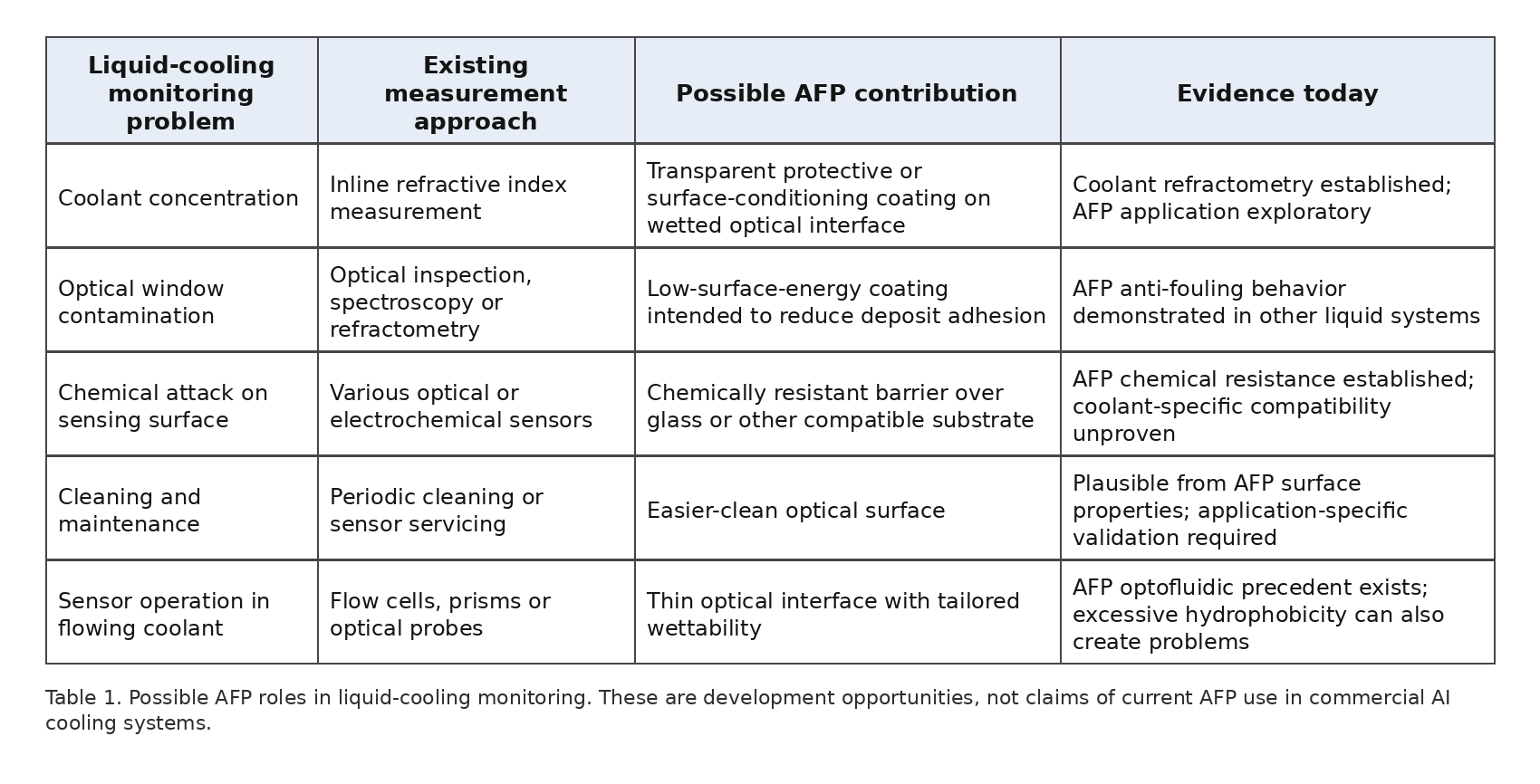 The opportunity for AFPs in AI cooling systems arises where the performance of a wetted optical surface becomes a limiting factor. The decisive experiment would be a long-duration comparison of coated and uncoated optical surfaces in representative coolant, measuring both deposit formation and sensor accuracy over time.
Why does this belong in the AI value chain?
AI demand is driving more powerful and more densely packed computing equipment. Higher thermal density is accelerating the use of liquid cooling. Liquid cooling creates new requirements for coolant control, materials compatibility and condition monitoring. Optical measurement is already being deployed for at least some of those tasks, including continuous measurement of coolant concentration.
AFPs potentially enter one level farther down the chain:
 AI is accelerating liquid cooling; that coolant quality must be monitored; optical methods such as refractometry are being used for that purpose; and AFPs combine several properties that could be useful at the wetted optical interface. That makes AFP-coated coolant sensors a credible development opportunity, but still an exploratory one.
Conclusion: the window is the opportunity
As AI systems push more heat into smaller spaces, liquid cooling is becoming part of the infrastructure required to operate them. Once coolant circulates beside some of the most expensive electronics ever manufactured, knowing the condition of that fluid becomes increasingly important. Optical sensors can provide some of that information, but they may be vulnerable to coolant chemistry, contamination or fouling.
Advanced materials are valuable because they solve a problem at a critical interface, and the amount of polymer required to coat an optical sensing window would be tiny compared with the physical scale of an AI data center. If an amorphous fluoropolymer coating can keep a coolant-monitoring optical surface clean, stable, and accurate for longer, it could earn a place in the AI value chain.
Learn More
If you are developing an optical coolant sensor, refractometer, flow cell, optical window or other liquid-monitoring device where chemical resistance, fouling, wettability or optical stability limits performance, Chromis Technologies can help evaluate whether a CyclAFlor® amorphous fluoropolymer is appropriate for the application.
Contact us to discuss the substrate, coolant chemistry, sensing wavelength, surface requirements and qualification conditions.
References
- International Energy Agency. Key Questions on Energy and AI. IEA, Paris, 2026. IEA
- NVIDIA. Hotter Than a Hot Tub: The 45°C Breakthrough to Cool AI’s Biggest Machines. June 21, 2026. NVIDIA Blog
- ASHRAE. Data Centers and Telecommunication Facilities. ASHRAE Handbook—HVAC Applications, Chapter 20. ASHRAE Handbook
- Open Compute Project. Advanced Cooling Facilities Reference Design Guidance and related Coolant Distribution Unit guidance. Open Compute Project
- Open Compute Project. A Chemical Perspective on Liquid Cooled Data Centers. OCP Educational Webinar Series, November 13, 2025. Open Compute Project
- Vaisala. Vaisala Polaris™ Process Refractometer Product Family. Vaisala.
- Chromis Technologies. CyclAFlor® Clear and CyclAFlor® Shield Product Information. Chromis Technologies
- “Nonstick” Membranes Prepared by Facile Surface Fluorination for Water Purification. Industrial & Engineering Chemistry Research 59 (2020). ACS Publications
- Optofluidic Sensor Based on Polymer Optical Microresonators for the Specific, Sensitive and Fast Detection of Chemical and Biochemical Species. Sensors 23, 7373 (2023). MDPI
- Chromis Technologies. CyclAFlor® Bespoke. Chromis Technologies
- ASHRAE. Energy and Thermal Efficiency: AI Data Center Energy Performance Framework. ASHRAE
- Open Compute Project. Vertiv CoolChip CDU — Project Deschutes 5. Open Compute Project
Frequently Asked Questions (FAQs)
Why is AI driving adoption of liquid cooling?
AI processors and servers are concentrating much more electrical power into each rack. The IEA reports that AI-server power density increased elevenfold between 2020 and 2025 and is expected to rise substantially again by 2027. Removing that heat increasingly requires liquid to be brought much closer to the processors than conventional air cooling allows. IEA
What needs to be monitored in a liquid-cooling system?
Typical systems monitor temperature, pressure and flow. Coolant condition can also require monitoring of concentration, conductivity, particulate contamination and other chemistry-related parameters depending on the fluid and cooling architecture. ASHRAE Handbook
How is refractive index used to monitor coolant?
The refractive index of a water-glycol mixture changes with glycol concentration. An inline refractometer can therefore continuously measure coolant concentration and provide a temperature-compensated signal to the data-center control system. Vaisala
Why might an AFP be useful on an optical coolant sensor?
AFPs combine optical transparency, chemical resistance, low surface energy and solution-based thin-film processing. Those properties could potentially help protect a wetted optical surface or reduce deposit adhesion while preserving the optical measurement.
Does low surface energy guarantee an anti-fouling surface?
No. AFP coatings have demonstrated reduced fouling in some other liquid systems, but fouling depends strongly on the contaminant, fluid chemistry and surface conditions. Data-center coolants would require application-specific testing. Very low wettability can also create undesirable bubbles or incomplete fluid contact in some microfluidic structures. ACS Publications
Are AFP-coated coolant sensors already used in AI data centers?
The public evidence reviewed here does not establish commercial use of AFP-coated optical coolant sensors in AI data centers. The opportunity should be considered exploratory.
What would need to be tested first?
A useful initial program would compare coated and uncoated optical substrates under prolonged exposure to representative data-center coolants. The key measurements would include optical transmission, coating adhesion, surface deposits, wettability, chemical stability and sensor drift before and after exposure.
Which CyclAFlor material might be relevant?
That would depend on the sensor and coolant. CyclAFlor® Clear provides a CYTOP-like refractive index around 1.34, while CyclAFlor® Shield can provide an even lower index and very low surface energy. The choice would need to be based on the desired optical behavior, surface properties, adhesion, coolant compatibility and coating process rather than refractive index alone. Chromis Technologies